
 Spanish
 Portuguese
 Arabic (Saudi Arabia)
 Chinese (Mandarin)
 Urdu (پاکستان)



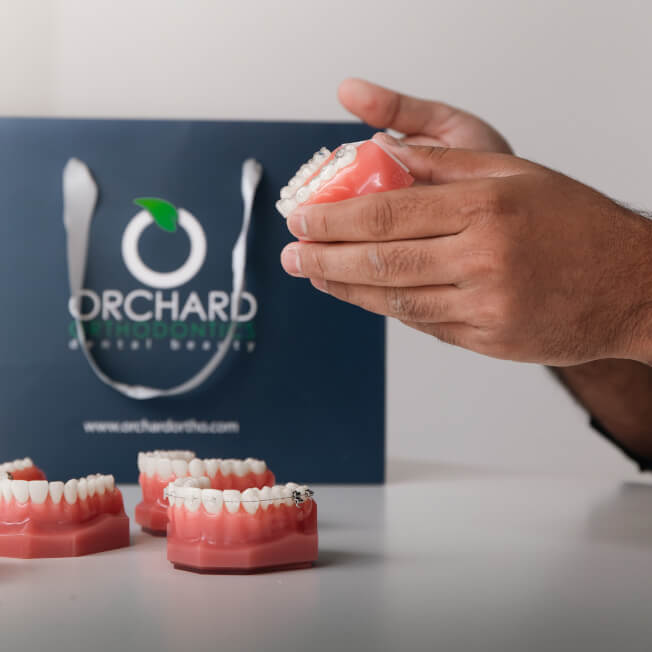
Choosing to straighten your teeth is an exciting milestone, but deciding how to do it can feel overwhelming. If you have recently visited the orthodontist, you were likely presented with two major options: fixed braces or removable clear aligners.
Many of our patients at Orchard Orthodontics find themselves stuck between the two. A very common worry is whether taking aligners out every time you eat or drink will become a frustrating daily hassle.
To help you decide, let’s look at the real-world pros and cons of both systems so you can choose the one that perfectly fits your routine.
The fixed braces approach: set it and forget it
Traditional fixed braces are a time-tested, highly reliable way to achieve a straight smile. In fact, they remain the most popular choice at our practice, with 61% of our surveyed Orchard patients opting for fixed braces. The single biggest advantage of a fixed brace system is that it stays in place permanently throughout your treatment journey.
- The pros: there is no risk of losing your braces, you don’t have to count your daily wear hours, and you never have to remove them before a meal.
- The cons: because they cannot be removed, food frequently gets trapped between the brackets and wires, making cleaning a bit more tedious. You will also need to cut out certain foods entirely, including hard, sticky or chewy treats that could damage the appliance.
To learn more about how modern brackets work, visit our fixed braces service page.
The clear aligner approach: total dietary freedom
Clear aligner systems offer a modern, highly flexible alternative to traditional brackets, and their popularity is growing rapidly — representing 39% of our patient treatments. The standout feature here is that they are fully removable. Comfort is also a massive deciding factor: in our recent clinic survey, the majority of patients perceived clear aligners as the less painful option compared to fixed braces.
- The pros: you can eat and drink whatever you wish. Because you take them out to eat, there are absolutely no dietary restrictions.
- The cons: they require personal discipline. Your aligners must be removed immediately before consuming any food or drink (except plain water) and popped back in right after.
Curious about clear-tray treatment? Check out our clear aligners / Invisalign® page.
“But isn’t taking them out all the time a hassle?”
It is a common misconception. We once looked after a patient who initially assumed that fixed braces would make her life much easier, simply because they required less daily management. However, once we showed her a live demonstration of how effortless clear aligners are to use, she changed her mind on the spot. The process of removal and insertion is incredibly easy and takes only a few short seconds.
Frequently asked questions
How many hours a day do I need to wear clear aligners?
For the treatment to be effective, you need to wear your aligners for 22 hours a day. They should only be taken out to eat, to drink anything other than water, and to brush your teeth.
Are clear aligners completely invisible?
While they aren’t completely invisible, they are made of medical-grade, transparent plastic, making them highly discreet and barely noticeable in everyday conversation compared to metal brackets.
Do fixed braces hurt more than aligners?
Both systems can cause some temporary soreness or pressure when first fitted or adjusted, as your teeth begin to move. However, aligners tend to cause less irritation to the inside of your cheeks and lips, since they don’t have metal brackets or wires.
Can I still play sports or musical instruments with braces?
Yes. If you choose fixed braces, we recommend wearing a protective orthodontic mouthguard during contact sports. If you choose aligners, you can simply take them out during your game or practice — just remember to put them right back in afterwards.
Which is right for you?
Every smile is unique, and the best system depends entirely on your day-to-day habits. Dr Sadiq advises choosing fixed braces if you want a hands-off treatment that works automatically without you needing to think about it. On the other hand, opt for clear aligners if you want a discreet look, refuse to give up your favourite crunchy or sticky foods, and don’t mind a quick routine at mealtimes.
Still unsure which one feels right? The best way to decide is to see and handle them yourself. Book a free consultation with Orchard Orthodontics today, and our expert team will gladly show you exactly how both options work.
Back 8 Brixton Hill Brixton


 Open in Google Maps