
 Spanish
 Portuguese
 Arabic (Saudi Arabia)
 Chinese (Mandarin)
 Urdu (پاکستان)



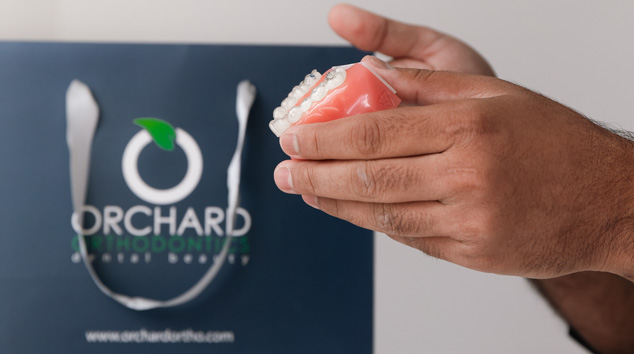
You've been counting down the aligners. You're on the home stretch - or so you thought. Then at your last appointment, your orthodontist tells you that you need a refinement. Before you panic, a refinement is not a sign that something has gone terribly wrong. It's a completely normal, and often expected, part of the clear aligner journey.
At Orchard Orthodontics, we use clear aligners including both Invisalign® and Angel Aligners to help our patients achieve beautiful, healthy smiles. Refinements apply to both systems - so whether you're mid-way through your Invisalign® treatment or nearing the end of your Angel Aligners plan, this guide is for you.
So, what exactly is a refinement?
A refinement is an additional set of clear aligners that your orthodontist prescribes when your teeth haven't quite moved to where the original treatment plan predicted. Think of it as a course correction - a way to fine-tune your results and get you to the finish line.
Clear aligner treatment is highly precise. Teeth are living structures attached to bone, and biology doesn't always follow a perfectly predictable path. Refinements exist precisely because your orthodontist is committed to getting your result exactly right - not just close enough.
Why might you need a refinement?
There are two main reasons a refinement may be recommended.
The first is that your teeth responded differently than expected. Teeth move through bone, and every patient's biology is unique. Sometimes teeth don't track exactly as the digital treatment plan predicted. This isn't unusual - it simply means your body needs a slightly different approach.
The second is that aligner wear wasn't quite consistent. Clear aligners need to be worn for at least 20-22 hours per day to work effectively. If aligners were removed more than recommended - during meals, sports, or social occasions - the teeth may not have moved as much as planned during that phase.
What does the refinement process involve?
The process is very similar to starting treatment, and most patients find it straightforward.
Your orthodontist will first take new impressions or digital scans of your teeth in their current position, along with updated photographs. From there, they'll create a revised treatment plan, typically building on your original agreed goals - and if there's a reason to make any changes, they'll discuss this with you.
Finally, a fresh set of aligners is fabricated and delivered to the practice, which you'll wear exactly as you did before.
Will there be any additional procedures?
Depending on what movements are needed, your refinement plan may include some additional clinical steps.
Attachments are small tooth-coloured 'handles' bonded to your teeth that give the aligners extra grip for more complex movements.
IPR (Interproximal Reduction) involves gently removing tiny amounts of enamel between teeth to create the space needed for alignment.
Elastics - small rubber bands - can be used to guide the bite and jaw position.
None of these are unusual; they're standard tools your orthodontist uses to get your result exactly right.
Does needing a refinement mean treatment has failed?
Absolutely not. Refinements are a normal, built-in part of the clear aligner process. The majority of Invisalign® and Angel Aligners cases include at least one refinement phase. It's a sign your orthodontist is being thorough - not that something has gone wrong.
What matters most is that you end treatment with a result you're genuinely proud of. A refinement is simply one of the tools that helps make that happen. There may be small bumps in the road, but with the right care and compliance, you will get there.
How to get the most out of your refinement
Now that you understand what a refinement is, here's how to make sure your next aligner series works as hard as possible.
Wear your aligners consistently
Wear your aligners for the full 20-22 hours a day recommended by your orthodontist. Only remove them to eat, drink anything other than water, and brush your teeth.
The more consistent you are, the more predictable your tooth movement will be - and the less likely you'll need further corrections.
Attend every review appointment
Keep every scheduled review appointment. These check-ins let your orthodontist track your progress and catch any issues early.
If you ever feel your aligners aren't fitting properly or something doesn't seem right, give us a call - don't wait for your next scheduled visit.
Have questions about your treatment?
Our team at Orchard Orthodontics is always happy to help. Whether you're wondering about a refinement or just want to understand your treatment plan a little better, book a free consultation and we'll talk you through it.
Back 8 Brixton Hill Brixton


 Open in Google Maps